
Funds Flow Statement is a statement used by a company to determine the change in the Financial Position of a company between two years (or two balance sheets). It is also known as Statement of Sources and Applications o…
Showing posts with label financial management. Show all posts
Showing posts with label financial management. Show all posts
Thursday, June 25, 2020
Monday, June 22, 2020

Working Capital of a company is the capital that is utilized by a company to finance its day to day operations. It is the measure of a company’s liquidity. Working Capital is also known as the Net Working Capital. Workin…
Forecasting of cashflows is a key practice in the industry, the Treasury Department forecasts the cash flow upon which fund-related decisions are taken to ensure sufficient funds for day to day operations. However, the …

Working Capital Management has two objectives: Ensure the availability of funds for day to day operations Utilize the asset efficiently to generate maximum profit. A company has certain inflows and outflows of cash ever…
Working Capital Management ensures that a company has sufficient funds to finance its day to day operations. If the cash flow of the company is a deficit and the company requires money to carry out its operations, then …
Monday, June 1, 2020
One of the goals of Working Capital Management is to ensure that the company’s asset is efficiently utilized to generate profits for the company. A company may have surplus cash flow which is not required to finance th…
Prediction and forecast form the major part of any business plan, the decision regarding the future are taken based on the past trends in the industry. This holds for the Working Capital management as well and the Treas…
Monday, May 11, 2020

No IRR Internal rate of return of cash flow is the rate at which NPV or the Net Present Value becomes Zero, however, there are some cashflows whose NPV never becomes Zero. Illustration 1: ABC Ltd. has invested Rs. 2000 …
Friday, May 8, 2020
Capital Budgeting is the process of evaluating various projects and investment ideas based on their future net cash flow. An investment is considered viable only if it is profitable, capital budgeting helps to find the …
Wednesday, May 6, 2020

Profitability Index measures the ratio between the present value of future cash flows to the initial investment. PI is also known as Value Investment Ratio (VIR) or Profit Investment Ratio (PIR).
Tuesday, May 5, 2020

Capital Budgeting is a process to evaluate the profitability of an investment opportunity for a company. It evaluates the profitability by comparing the expenses incurred and the revenue generated from the investment.
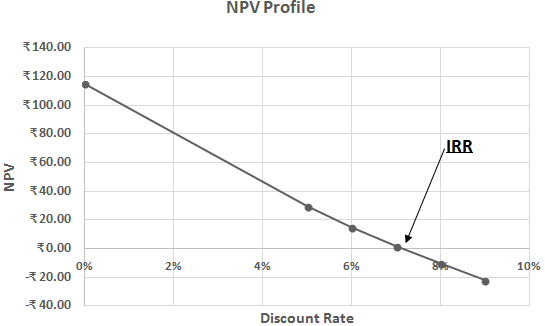
NPV Profile is the graphical representation of NPV at various discount rates. This is used to study the trend in variation of NPV with respect to the Discount Rate. NPV Profile is also used to study the crossover rate …
NPV or Net Present Value if the method to calculate the profitability of a project-based of tax-free future cash flows. The higher the NPV, the greater is the profitability. IRR or Internal Rate of Return is the rate at…

Present Value implies the present value of a sum of money receivable at a future time. The money receivable in the future may be a cash flow payable over a period or a one-time return.

Capital Budgeting refers to the process of evaluating a project or an investment in terms of the cost associated with the returns expected upon certain rules and principles. The principles of the Capital budgeting are t…
Monday, May 4, 2020

Average Accounting Rate of Return is a technique that measures the profitability of a project using the accounting profits of the company. ARR is the average net income expected by a project divided by the average capit…

Internal Rate of Return is the rate at which the Net Present Value is Zero. This is among the most used calculation in Capital Budgeting. IRR is also known as Discounted Cash Flow of Return or Economic Rate of Return.

Payback Period is the time required to recover the original cost of an investment from the net cash flows without considering the time value of money. In simple words, it is the time by which the project returns the ori…

Discounted Payback Period is the time required to recover the original cost of an investment from the net cash flows considering the time value of money. It is an enhanced version of the Payback Period where the time va…
Friday, April 17, 2020
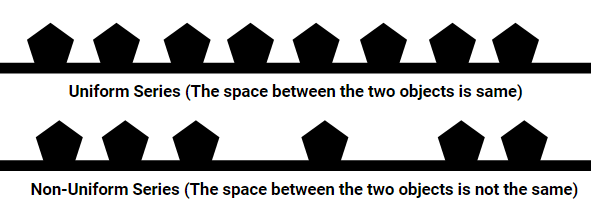
Future Value of a Series of Cash Flow is used to determine the total worth of continuous cash flow of some years at a prevalent rate of interest. In simple words, it is the total return to be obtained after the maturit…
