

No IRR Internal rate of return of cash flow is the rate at which NPV or the Net Present Value becomes Zero, however, there are some cashflows whose NPV never becomes Zero. Illustration 1: ABC Ltd. has invested Rs. 2000 …
Showing posts with label Capital Budgeting. Show all posts
Showing posts with label Capital Budgeting. Show all posts
Monday, May 11, 2020
Friday, May 8, 2020

Capital Budgeting is the process of evaluating various projects and investment ideas based on their future net cash flow. An investment is considered viable only if it is profitable, capital budgeting helps to find the …
Wednesday, May 6, 2020

Profitability Index measures the ratio between the present value of future cash flows to the initial investment. PI is also known as Value Investment Ratio (VIR) or Profit Investment Ratio (PIR).
Tuesday, May 5, 2020

Capital Budgeting is a process to evaluate the profitability of an investment opportunity for a company. It evaluates the profitability by comparing the expenses incurred and the revenue generated from the investment.
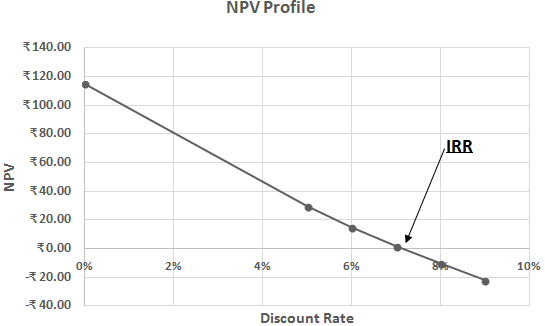
NPV Profile is the graphical representation of NPV at various discount rates. This is used to study the trend in variation of NPV with respect to the Discount Rate. NPV Profile is also used to study the crossover rate …
NPV or Net Present Value if the method to calculate the profitability of a project-based of tax-free future cash flows. The higher the NPV, the greater is the profitability. IRR or Internal Rate of Return is the rate at…

Present Value implies the present value of a sum of money receivable at a future time. The money receivable in the future may be a cash flow payable over a period or a one-time return.

Capital Budgeting refers to the process of evaluating a project or an investment in terms of the cost associated with the returns expected upon certain rules and principles. The principles of the Capital budgeting are t…
Monday, May 4, 2020

Average Accounting Rate of Return is a technique that measures the profitability of a project using the accounting profits of the company. ARR is the average net income expected by a project divided by the average capit…

Internal Rate of Return is the rate at which the Net Present Value is Zero. This is among the most used calculation in Capital Budgeting. IRR is also known as Discounted Cash Flow of Return or Economic Rate of Return.

Payback Period is the time required to recover the original cost of an investment from the net cash flows without considering the time value of money. In simple words, it is the time by which the project returns the ori…

Discounted Payback Period is the time required to recover the original cost of an investment from the net cash flows considering the time value of money. It is an enhanced version of the Payback Period where the time va…
